

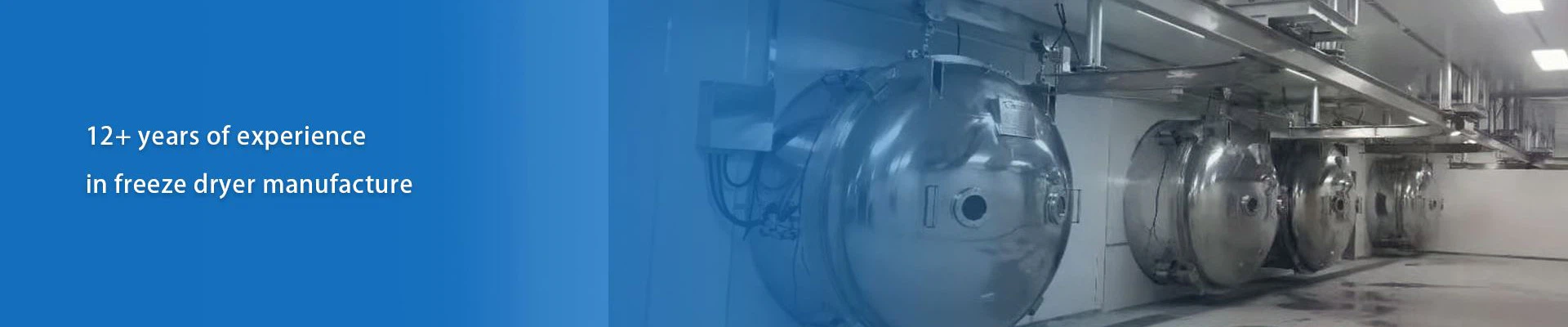
In order to ensure that the ice in the material does not dissolve, the freeze dryer directly vaporizes (sublimates), and continuously removes the vapor to ensure normal sublimation. The vacuum degree in the freeze dryer must be lower than the saturated vapor pressure of ice at a certain temperature (610pa). the following).
The cold trap is used to capture water vapor and reduce the load of the vacuum pump. A properly designed cold trap will basically not cause the vacuum pump to fail, and the energy consumption is also low. However, the design requirements of the refrigeration system and the cold trap are stricter.
As the ice continues to sublime and the vapor is removed, it also takes away the heat of the material, so that the temperature of the material (ice temperature) continues to decrease, so that the saturated vapor pressure of the induced steam ice decreases, and the sublimation speed slows down. In order to maintain a certain sublimation rate, it is necessary to continuously add heat to the material. Too little heat supplementation will reduce the sublimation rate, and too fast heat supplementation will cause ice to melt, resulting in material collapse and freeze-drying failure.

Since the freeze-drying process of the freeze-drying machine is complicated and the working state is narrow, the quality of the freeze-dried product will deteriorate if it is not careful, so an automatic control system is required. The design of the automatic control system of the freeze-drying machine requires an easy operation, starting from the button of putting in the material, quick-freezing vacuum sublimation drying in one go, and prompting the shutdown to discharge after the completion of freeze-drying. Relevant temperature and pressure control points should be carefully selected and reasonably controlled, the relationship between quick freezing, vacuum holding, and heating should be properly controlled, and process curves should be set for different materials.
The vacuum freeze-drying technology of freeze dryer has a wide range of applications in the fields of bioengineering, pharmaceutical industry, food industry, material science, and deep processing of agricultural and sideline products. Freeze-drying of medicines includes two parts: western medicine and traditional Chinese medicine. Western medicine freeze-drying has been developed to a certain extent in China, and many larger pharmaceutical factories have freeze-drying equipment. In terms of traditional Chinese medicine, it is still limited to the freeze-drying of a small amount of traditional Chinese medicinal materials such as ginseng, velvet antler, yam, and Cordyceps Sinensis. A large number of Chinese patent medicines have not yet adopted the freeze-drying process, which is far behind foreign countries. In the field of biotechnology products, freeze-drying technology is mainly used in the production of serum, plasma, vaccines, enzymes, antibiotics, hormones, and other drugs; biochemical inspection drugs, immunology and bacteriology inspection drugs; blood, bacteria, arteries, bones, skin, cornea, nerve tissue and various organs for long-term preservation.


