

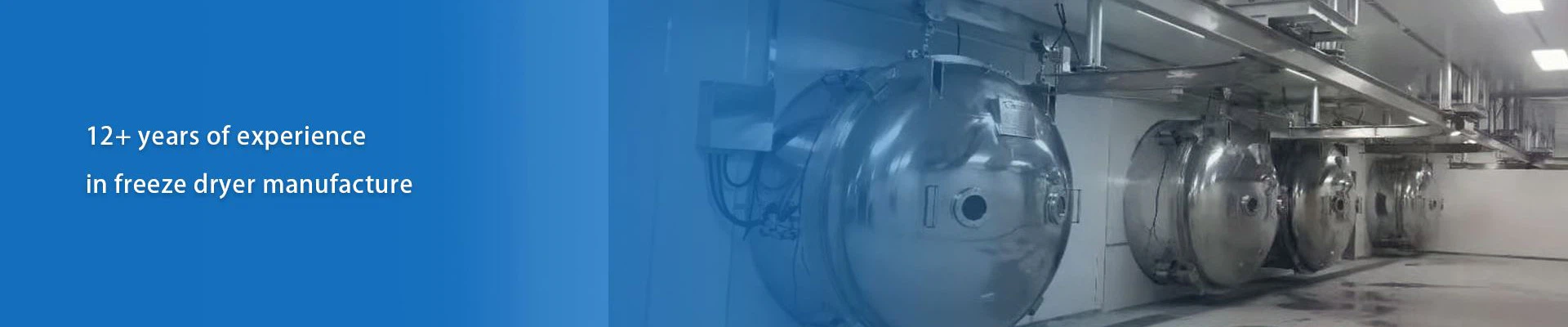
Fresh fruits and vegetables are highly seasonal and difficult to store. Drying is one of the most widely used technologies in fruit and vegetable preservation. With the rapid development of fruit and vegetable leisure foods, the research on drying technology has continued to deepen. Relevant research at home and abroad mainly focuses on processing technology and its process parameters, drying dynamics, and the quality of dried fruits and vegetables. Low-energy processing technology is used to retain the nutrients of fresh fruits and vegetables to the greatest extent in the shortest possible drying time, and obtain better sensory quality.
The freeze-drying process of the vacuum freeze dryer is carried out in a vacuum and low-temperature environment, which will not destroy heat-sensitive substances, and also inhibits the biological activity of enzymes and the growth and reproduction of microorganisms. Therefore, the color, aroma, taste, shape and nutritional components of fresh fruits and vegetables can be better preserved, and high-quality dried fruit and vegetable products can be prepared. Therefore, freeze-dried fruits and vegetables can meet consumers' pursuit of nutrition, deliciousness and health of fruit and vegetable foods. However, due to high cost, high energy consumption and low yield, it is also one of the most expensive drying processes. In order to achieve large-scale industrial production, it is necessary to further optimize or adopt more effective combined drying technology to achieve high quality and low energy consumption requirements.
Studies have shown that in addition to the drying conditions, dryer type and material characteristics that affect the quality and drying energy consumption of freeze-dried fruits and vegetables, pre-drying treatment and pre-freezing conditions also play an important role in the freeze-drying process. In addition, compared with a single drying technology, freeze-drying technology, as a composite technology of staged drying, combines the advantages of freeze drying and other drying methods to achieve complementarity, and has good advantages in drying quality, cost and energy consumption. Therefore, it has attracted widespread attention from scholars and the industry at home and abroad and has broad application prospects.
According to different drying mechanisms, drying is divided into hot air drying, microwave drying, vacuum drying, FD (freeze drying) and infrared drying. Although hot air and microwave production costs are not high and are widely used in industry, they seriously affect product quality due to serious nutrient loss and poor heating uniformity; the other three drying methods have obvious advantages in product quality, but due to various technical reasons such as difficult heat transfer in vacuum drying, high energy consumption in FD production, and limited penetration ability of infrared drying, it is difficult to apply them on a large scale in production practice.
Vacuum freeze dryer FD (freeze drying) is based on sublimation dehydration. Under the low temperature environment required for drying, it can minimize the loss of flavor and aromatic compounds, produce porous structures, and reduce volume shrinkage; in addition, due to the cessation of most enzymatic reactions, the initial state of fresh fruits and vegetables is maintained, and the products have good quality.
However, due to the operation of maintaining a low temperature state, providing sublimation heat, and reducing the total pressure of the drying chamber, vacuum freeze drying machine FD (freeze drying) is a high-energy consumption and high-cost production technology. Therefore, improving the entire drying process, improving drying efficiency, and reducing energy consumption have become the hot spots of many studies.
Let's briefly mention the mathematical modeling and optimization of the drying process of vacuum freeze drying machine.
Drying kinetics is usually used to describe the macroscopic and microscopic mechanisms of heat and mass transfer in the drying process. It is affected by many factors such as drying methods, drying conditions, and material characteristics. It is of great significance in improving equipment design, optimizing drying processes, and maintaining quality and reducing consumption. Thin layer drying is a widely used method for determining the kinetic model of fruit and vegetable drying. The relationship between moisture ratio MR and time t is often used to describe the dynamic changes in the drying process. The accuracy of the model is verified by statistical indicators such as determination coefficient R2, chi-square χ2, and mean square error RMSE. It can be used as an important tool to estimate the drying curve, improve the drying process, and achieve low energy consumption. However, in practical applications, there is no thin layer drying model that can effectively summarize all the drying kinetics of fruits and vegetables. In terms of improving quality and reducing consumption, in addition to optimizing the drying process by establishing a drying kinetic model and changing drying parameters, current research is also mainly focused on controlling pretreatment methods, prefreezing methods, and using combined drying technology.


