



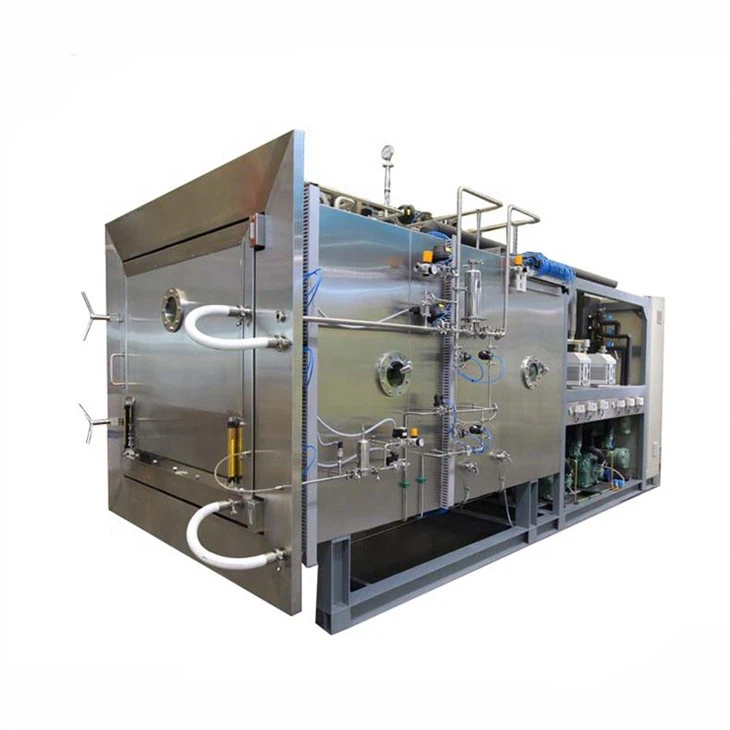


Laboratory Lyophilizer
Laboratory lyophilizer
The use of the experimental lyophilizer is very simple, you will know after reading
The experimental lyophilizer is mainly small, mainly used in university laboratories, scientific research institutions and enterprises in medicine, food and other related industries. The lyophilizer is currently in the pilot and production stages. The pilot-scale lyophilizer adopts separate design of drying chamber and cold trap, using silicone oil as heat conduction medium, which is not only conducive to energy saving, but also conducive to speeding up the production speed (equipped with electric defrosting), and convenient cleaning.

This product can be equipped with automatic plug function according to the requirements of experiment or production. This kind of lyophilizer has the advantages of flexible configuration, excellent performance, energy saving and environmental protection, and conforms to the production requirements of the vast majority of experiments and pilot tests.
The detailed use process of the experimental lyophilizer is as follows:
A: sample placement
1. Put the pretreatment items in the material tray, and then put the material tray in the lyophilized rack.
2. Place the temperature sensor on any material plate to measure the temperature of the material.
3. Put the lyophilized rack into the cold trap, cover the insulation cover, and prepare for pre-freezing.
Two: sample pre-freezing
1. Open the main power switch on the back of the equipment.
2. Click the center of the screen to enter the interface, and click the "Refrigerator" button to start the pre-freezing. It is recommended to pre-freeze for about 4 hours
3. After the goods are completely frozen, take out the lyophilized rack from the cold trap.
Three: sample drying
1. Take out the freeze-drying rack from the cold well, and then put the support plate of the freeze-drying rack at the cold well head, put the freeze-drying rack on the support plate, or put the material plate behind the freeze-drying rack, and then put the freeze-drying rack directly above the cold well.
2. Place the probe on the material tray of any layer and cover it with a glass cover.
3. Tighten the drainage inflation valve.
4. Click the "pump is 110kPa" button on the screen of the vacuum gauge to display. The vacuum degree drops rapidly until the vacuum degree is less than or equal to 10Pa, and the drying starts formally (it is recommended to dry for about 20 hours, which is determined by the user according to the moisture content of the material).
Four: take out the sample
1. Check the sample curve and visually check whether the sample is completely dry. After opening the empty-charging valve, click the "Vacuum Pump" button to stop the operation of the vacuum pump. Click the "Vacuum Gauge" button to turn off the vacuum gauge.
2. Remove the glass cover of the lyophilized machine used in the experiment, take out the material tray from the lyophilized shelf, and pack the samples on the tray. Click the "Refrigerator" button to turn off the compressor and the equipment stops running.
Parameter:
Model | KFD-20 | KFD-25 | KFD-30 | KFD-50 |
Tray area(m²) | 20 | 25 | 30 | 50 |
Input capacity(kg/batch) | 200 | 250 | 300 | 500 |
Min. cold trap temperature(℃) | <-45℃ | <-45℃ | <-45℃ | <-45℃ |
Vacuum degree(pa) | <10pa | <10pa | <10pa | <10pa |
Tray temp. | -35~+100℃ | -35~+100℃ | -35~+100℃ | -35~+100℃ |
Tray quantity | 18 | 22 | 18 | 28 |
Tray Size(mm) | 2200x600 | 2200x600 | 3300x600 | 3300x600 |
Cooling method | Water cooled | Water cooled | Water cooled | Water cooled |
Total power(kw) | 45 | 50 | 60 | 100 |
Total weight(kg) | 8000 | 9000 | 11000 | 20000 |


Hot Tags: laboratory lyophilizer, China, factory, suppliers, manufacturers, customized, price, made in China, freeze dryer for home use, freeze dried yogurt, lyophilization process, pre freezing dryer LCD freezing dryer, freeze dryer diy, lyophilizer in india
You Might Also Like



Send Inquiry